The Challenge
Blings enabled creators to build personalized videos by connecting video layers to dynamic customer data.
A simple project could contain dozens—or even hundreds—of text layers, image placeholders, colors, buttons, and interactive elements, each requiring its own connection to a data source.
The existing workflow treated every layer as an independent task.
To personalize a video, users repeatedly selected a layer, chose a connector, mapped a data source, configured its behavior, and repeated the process for every similar layer.
As projects became larger, the workflow became increasingly repetitive.
Users spent more time configuring relationships than thinking about the experience they wanted to create.


User flow of CTA creation using 3 connectors
User interviews and workflow observations revealed that the bottleneck wasn’t the number of layers.
It was the number of repeated decisions.
Although many layers shared the exact same behavior, the product required users to configure each one independently.
This created several problems:
-
Visual clutter caused by an ever-growing list of connectors.
-
Repetitive interactions that increased cognitive load.
-
Longer production times for complex projects.
-
Higher risk of inconsistent configurations across similar layers.
The interface reflected the system’s implementation rather than the user’s intent.
Key Insight
Users weren’t trying to connect individual layers - They were trying to apply the same behavior across groups of layers.
The product treated connectors as one-to-one relationships - Users thought of them as reusable behaviors.
That difference became the foundation of the redesign.
Instead of designing connectors as objects attached to individual layers, I reframed them as reusable effects.
Designing the Solution
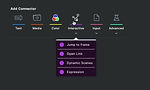

A connector became a single behavior that could be applied across multiple compatible layers.
This shifted the workflow from configuring individual elements to defining reusable logic.
The interface evolved from managing dozens of isolated connectors to managing a smaller set of meaningful behaviors.
By changing the conceptual model—not just the UI—we reduced repetitive work while making larger projects significantly easier to understand.
Collaboration
The redesign required close collaboration with engineering to redefine how connectors were represented throughout the platform.
Together we balanced technical implementation with an interaction model that felt intuitive to creators, ensuring the new abstraction remained flexible enough to support future connector types.
Impact:
Reduced approximately 6 interactions for every connected layer.
Significantly reduced connector clutter in large projects.
Made complex personalization workflows easier to understand.
Introducing a streamlined process
Created a scalable foundation for introducing new connector types
without increasing interface complexity.
Reflection
his project reinforced an important lesson for me:
When users repeat the same action dozens of times, the problem usually isn’t efficiency—it’s abstraction.
Instead of optimizing an existing workflow, I looked for the underlying concept users were trying to express.
Reframing connectors as reusable effects didn’t just reduce clicks. It introduced a more scalable mental model that could grow with the complexity of the product.